
Bioengineering as a Discipline
Soil bioengineering — sometimes called biotechnical engineering or green engineering — refers to the use of living plant material as a primary structural component in slope and bank stabilisation. The discipline has a documented history in central European river management stretching back several centuries, with willow and alder systems recorded in historical Polish and German river works.
The renewed emphasis on bioengineering in contemporary Polish practice reflects both the ecological requirements of the EU Water Framework Directive and growing recognition that purely hardened revetments can increase downstream erosion by altering sediment transport dynamics. Vegetation-based approaches address bank surface erosion while maintaining greater geomorphological connectivity within the river system.
Mechanisms of Vegetation-Based Bank Protection
Living vegetation protects riverbanks through several concurrent mechanisms:
- Root reinforcement: Root networks bind the bank soil into a composite material with greater cohesion and shear strength than unvegetated substrate. Willow roots in particular penetrate to depths of 1.5–2.5 m in alluvial soils, reinforcing the zone most vulnerable to lateral erosion.
- Canopy interception: Overhanging vegetation reduces the energy of rainfall impact on exposed bank faces, reducing rill erosion during precipitation events.
- Stem and leaf resistance: Dense streamside vegetation reduces near-bank flow velocity, limiting shear stress on the bank surface during moderate flow events.
- Sediment trapping: Vegetation stems and root mats trap suspended sediment, gradually rebuilding eroded bank profiles over successive flood seasons.
Willow Systems in Polish River Management
Several willow (Salix) species native to Polish riparian habitats are the most widely used plants in bioengineering works. Their value derives from their vigorous vegetative propagation — cuttings and stakes taken from dormant material in late autumn or early spring will root readily in moist bank conditions without supplemental irrigation.
Species commonly specified in Polish bioengineering guidance include:
- Salix viminalis (common osier) — highest growth rates, used primarily for fascine bundles and wattle fencing
- Salix fragilis (crack willow) — larger form, used as live stakes for taller bank reinforcement
- Salix alba (white willow) — widespread on lowland Polish rivers, produces deep root systems suitable for sandy alluvial banks
- Salix purpurea (purple willow) — more compact, used in combination plantings
Non-native or hybridised willow cultivars are generally avoided in Polish conservation-sensitive areas, as native provenance material is required for Natura 2000 habitat management adjacent to watercourses subject to Habitats Directive protections.
Fascine Bundles: Construction and Placement
A fascine is a bundle of cut willow or other flexible vegetation, typically 0.15–0.30 m in diameter and 2–3 m in length. Fascines are placed horizontally in trenches cut into the bank face at approximately 0.5–1.0 m vertical intervals. Each bundle is staked in place with wooden or steel stakes driven through the bundle into the bank. Pairs of bundles are sometimes placed at the same elevation in a double-row configuration for greater initial coverage.
Live fascines — composed of material capable of rooting — must be installed during the dormant season, typically November through March in the Polish climate, to allow root development before spring growth. Dead fascines of cut reed or brushwood provide immediate physical protection but do not contribute long-term root reinforcement.
The trench backfill covers the lower half of each bundle, with the upper surface exposed. As the stems root into the bank and produce lateral growth, the surface between bundles progressively covers with vegetation. In monitored case studies from Polish lowland rivers, full surface cover between fascine rows is typically achieved within two to three growing seasons under adequate moisture conditions.
Live Staking
Live staking involves the insertion of willow or alder cuttings directly into the bank without pre-preparation of trenches. Stakes of 20–40 mm diameter and 0.5–1.0 m length are driven with approximately two-thirds of their length below the surface at intervals of 0.5–1.5 m across the bank face. This technique is best suited to bank slopes of 1:2 or shallower where driving stakes to depth is practicable.
The simplicity of live staking makes it cost-effective for treatment of large bank areas, and it is commonly specified as an addition to other bioengineering works rather than as a standalone measure. On sandy Vistula terrace banks, where soils have low cohesion, staking alone may be insufficient during the establishment period, and a combined approach with fascines or erosion control mats is preferable.
Brush Layers and Wattle Fencing
Brush layers are live willow branches placed in near-horizontal layers within the bank face during construction of a new or regraded bank. They are then covered with compacted soil. As the branches root, a zone of reinforced material develops within the bank cross-section rather than just on its surface, making brush layers more effective than surface-only techniques where deep-seated erosion or instability is anticipated.
Wattle fencing — interwoven willow branches between driven stakes — has been used in Polish river management for retaining regraded bank surfaces and providing immediate sediment trapping at the bank toe. The woven structure holds its form for the one to three seasons needed for rooting plants to take over structural function from the dead woody material.
Combined Stone and Vegetation Approaches
Purely vegetative bank protection is generally limited to locations where flow velocities do not exceed approximately 1.5–2.0 m/s during flood events. Above this threshold, shear stresses on the bank surface during the vegetation establishment period are likely to damage plantings before root systems are sufficiently developed. This constraint is significant in Poland's larger regulated rivers, where design flood velocities in many managed reaches exceed this limit.
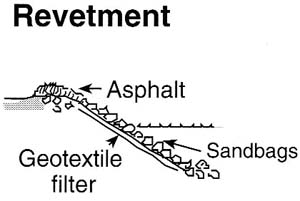
The most commonly applied resolution is a combined structure: stone revetment or gabion mattress protection below the ordinary high-water mark, with vegetation bioengineering applied to the bank face above that elevation. This zonation reflects the different hydraulic exposure of the submerged zone and the bank face above normal summer water levels. Wody Polskie technical guidance for bankside vegetation management acknowledges this combined approach as standard for many reach types on significant watercourses.
Note: The effectiveness of vegetation bioengineering depends critically on species selection, installation timing and soil moisture conditions. Works installed outside the dormant season on well-drained sandy substrates frequently fail to establish. Site assessment prior to design is necessary.
References and Further Reading
- Żelazo, J. & Popek, Z. — Podstawy renaturyzacji rzek (Fundamentals of river restoration) — SGGW, Warsaw (reference work on Polish river bioengineering)
- Water Framework Directive (2000/60/EC) — EU regulatory context for ecological requirements
- Wody Polskie — kzgw.gov.pl
- IMGW-PIB — imgw.pl
- Generalny Dyrektor Ochrony Środowiska (GDOŚ) — guidance on Natura 2000 site management and vegetation works on Polish watercourses — gdos.gov.pl

